Tell us a bit about your family and your new role with RF?
How many of you are there, and what does day-to-day life look like?
My new role with Rainbow Families is the Community Engagement Officer for the AC T. My job is to help facilitate the Seahorse Playgroup (Canberra’s first Rainbow Families Playgroup), as well as to support, promote and deliver Rainbow Families programs in the ACT. It is exciting that Rainbow Families is branching out to provide support to Canberran families.
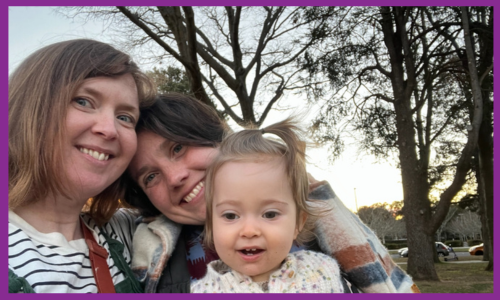
There are three of us in my little family. My partner Luch, our two year old daughter Mira and myself. Luch and I both work part time (3 days a week) and split 50/50 care for Mira. We both really enjoy spending time one on one with her as well as time together as a family. We all love spending time outside, playing music, making art and craft, cooking, reading, playing and going for swims.
Can you share a bit about your journey to parenthood?
What pathway did you take, and what were some of the key moments?
The journey to parenthood was a bit of a long and winding path for us. We started going through IUI and IVF during the pandemic lockdowns in Melbourne. It was difficult being so isolated from friends and family during such a big time. On top of this a lot of the procedures that were a part of the IVF process we're not allowed to have visitors so I went through a lot of the medical interventions on my own without Luch being able to be present. Our first embryo transfer Luch had to FaceTime into the appointment which was really weird. The staff tried their best to facilitate that for us but it was uncomfortable and felt like a strange way for her to be present.
We decided to move back to Canberra after the lockdown restrictions eased to be closer to friends and family. We found it so difficult to connect with a fertility service here that we decided to continue to travel to Melbourne for procedures rather than stay on the waitlists here. It was good to be able continue on with the same provider but the travel to Melbourne increased the financial impact for us.
A moment that is still very present for me was the loss of our first embryo transfer. There was a lot of grief and sadness that came with that loss. It felt hard wanting to stay hopeful and positive for each transfer but also holding space for the sadness and grief that came up. We were lucky to have a specialist that we trusted and that didn't pressure us to go through any part of the process until we were ready both financially and emotionally.
Was this always the plan, or did things change along the way?
Some families start solo, others grow over time — what’s your story?
Luch and I knew that we wanted to have children but the path to get there seemed like a total mystery. We hadn't seen or known the experience of any families that looked like ours and how they navigated the IVF process. So we had no idea what we were in for!
Did you face any challenges in creating your family?
What helped you get through them?
It seems like we faced a lot of challenges. There were financial challenges, the isolation of the lockdowns and the impact they had on our mental health, microaggressions and blatant homophobia as well as health challenges.
I had some health complications during pregnancy. I was diagnosed with Type 1 diabetes when I was three months pregnant. I have a family history of Type 1 Diabetes (from my dad) but it was a surprised to be diagnosed at 37. It was a difficult journey learning how to use insulin and manage a complex health condition with the added stress of being pregnant and the concern about the impact on the baby. This led to me developing chronic anxiety, which made the diabetes management even harder. There is a lot of information about the impact of high blood sugar on babies that well-meaning health professionals used to try to motivate people to be proactive with managing their diabetes. I am a very earnest person so I found this approach made me incredibly anxious and overwhelmed. I found seeing a psychologist through this time very valuable in helping me manage my mental health.
The diagnosis of type 1 diabetes also categorised my pregnancy and birth as high risk. This increased the amount of medical interventions and took away a lot of the choice around what type of birth I could have. I was scared of the idea of surgery and therefore scared of the idea of the C-section. I was also told that I had low blood platelet levels so if I was to have a C-section I would have to be totally unconscious and Luch would not be able to be present for the birth. This was something I really didn't want. I was also told it would be likely that Mira would have to spend some time in NICU when she was first born, as babies who are born to mothers with type 1 diabetes often experience an extreme drop in blood sugar when they're born. Luckily this wasn't the case for us and we were able to spend the first night all together rather than being separated.
Luckily I qualified for the continuity of care programme with the birth centre at Canberra hospital. Luch and I were blessed with an incredible midwife who helped us navigate the hospital and medical systems and advocated for our birth choices. I was induced at 38 weeks and I felt safe and supported during Mira’s birth.
When Mira was 5 days old, she had jaundice and had to spend a night in the special care nursery to have light treatment. Luch and I were not able to stay with her that night as the ward was for babies only. Separating from her that night was incredibly difficult. It also coincided with the 5 day drop in hormones that comes after birth, so I pretty much just cried the whole evening. Going home without your baby is very surreal. Luckily she only needed to be there for one night so we all got to go home in the morning.
How did you find support during the journey?
Were there people, communities, or services that made a difference?
Friends and chosen family were such a valuable support to us throughout this whole journey. We also started attending Seahorse Playgroup when Mira was six months old and connecting with other rainbow families was so valuable and integral to feeling seen and validated as a family.
What’s been a standout moment for you as a parent?
A small everyday joy or a big milestone?
I just love seeing Mira grow and develop and change. In the last couple of weeks, she has started singing and humming along to songs and it is so sweet and joyful to watch. I love seeing how rich and imaginative her inner world is and watching her experience things for the first time is a real joy. Watching Luciana become a parent has also been wonderful and I feel so lucky every day for my family.
Do you have any family traditions or routines that are special to you?
When we were going through the IVF process we found creating little homemade rituals very comforting and supportive. When we were going through an IVF cycle we would often light a candle in the evenings and read poems or share what we were thinking about or feeling worried about to each other. This became an important grounding process for us and helped us navigate the uncertainty and overwhelm.
We are really enjoying creating our own family traditions around important events such as Christmas and birthdays. I think as queer people we get to look at traditions and choose how we celebrate in a way that is supportive of our families. We don't just have to do it the way it has been done before.
What’s something you wish more people understood about LGBTQ+ families?
I wish more people understood that thinking a child needs to come from a heteronormative family structure to be healthy is harmful and just not true. Children can be loved, healthy , learn how to be good people and thrive being parented by people of any gender, sexuality or family structure. It seems clear to me that having parents that question the expectations of gendered norms and how they can cause harm allows children to be free to do the same thing, allowing them to be more authentically themselves rather than trying to fit in to what a ‘boy’ or a ‘girl’ has to be. I wish everyone could feel that freedom.
What advice would you give to someone just starting their journey to parenthood?
Rally support around you in whatever way feels good to you. Find the places and people that lift you up and that you can call on when you need to. We found getting out into nature really helpful when times got tough, as well as seeing close friends and family.
Have you had to advocate for your family in any settings, like school or health care?
What was that like?
I found I had to advocate for our family during our time in hospital as well as in our early parenting time. We had an obstetrician ask Luch “Who are you?” during an appointment to plan for the birth as well as lots of other microaggressions undermining her role as parent. It would have taken one minute for that obstetrician to read our file to know she is Mira’s Mum. Also a heterosexual family I am sure would never be asked a question like that. It was upsetting and hurtful to see people undermine Luch’s role as parent because of assumptions about biology.
It felt really jarring because we obviously had decided to become parents together, had gone through all the process of IVF together, had conceived Mira together, love and parent her together, that externally people weren't validating us as a family. I realised that for every medical appointment we had I had to proactively introduce Luciana as Mira’s ‘other mother’ which as a term in itself is weird but was the quickest way I could make the health professional know our family structure before they said something harmful.
What does being part of the Rainbow Families community mean to you?
I feel so proud of my family and being part of the Rainbow Families community helps me to feel connected, seen and validated as a family. I love meeting and getting to know new families. We know what it feels like to be marginalised so I am really committed to creating a space for people to feel welcome, connected and celebrated for who they are. Queer families are the future.
Is there anything you’d like to see change to better support LGBTQ+ families?
I am also a registered Arts Therapist and I feel passionate about advocating for Rainbow Families to feel safe, included and respected when accessing health services. I have recently received a Capital of Equality grant to undertake a community arts project involving families within the LGBTIQA+ community. The aim of the project is to create a series of zines that mainstream health providers can use as a resource to provide a more inclusive service to our rainbow families.